


CANBERRA, AUSTRALIA — A child deciding whether to spend or save is already making an economic choice. A child asking why one family can afford something another cannot is asking a harder question, about scarcity, fairness and the way society distributes opportunity. What began with fairy tales and a child’s questions is becoming a Canberra-born learning ecosystem spanning bestselling books, digital games, EconLab, school experiences, inclusive design and a deeper proposition: children should learn not only how economies work, but how to question whom they serve.
For economist and author Dr Helen Hoang, that distinction matters. Financial literacy can teach a child how to manage money. Economic literacy can help them understand the systems surrounding those decisions. Ethics asks the question that sits beneath both: what do our choices value, who benefits, and who may carry the cost?
That philosophy now anchors Economics for Kids, Hoang’s Canberra-based education initiative. What began as an attempt to explain economics to her young son through fables and fairy tales is developing into a broader learning ecosystem built around a simple progression: read the idea, experience the decision, reflect on the consequence, and apply the learning to real life.
“The goal is not simply to raise financially capable consumers. It is to help raise thoughtful, ethical citizens who understand that choices have consequences for themselves and for others.”
A Child’s Question, and a Much Bigger Question
The origin of the project is personal. Hoang has written about growing up in a remote village in northern Vietnam, where scarcity was not an abstract classroom concept but part of daily life. Years later, her son’s questions about money, toys and why some people have more than others brought those memories into a new context.
Her response was not to make economics smaller. It was to make it more human. In her 2025 essay for The Ethics Centre, Hoang argued that children should learn to move beyond “Can I afford this?” toward questions about hidden costs, fairness, responsibility and the people affected by economic choices. The proposition is subtle but important: economics education should build agency without losing empathy.
This gives Economics for Kids a purpose beyond conventional money education. Saving and budgeting matter, but so do scarcity and justice, incentives and values, markets and trust, technology and responsibility. Children are not merely future earners or consumers. They are future citizens who will participate in, question and eventually help shape economic systems.
Why Fairy Tales Work
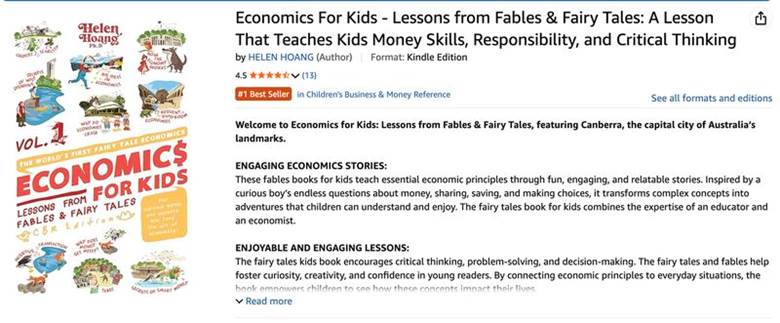
Hoang’s first educational bridge was storytelling. Economics for Kids: Lessons from Fables & Fairy Tales reimagines familiar stories as encounters with scarcity, opportunity cost, incentives, saving, inequality, trade, public goods, innovation and other economic ideas.
The approach works because stories already contain the moral architecture of economics: desire and constraint, exchange and sacrifice, power and fairness, action and consequence. A mermaid who gives up her voice for something she wants is making a trade-off. An ant preparing for winter is making an intertemporal choice. A community sharing limited resources is confronting questions of allocation and cooperation.
HerCanberra described the series as weaving 20 timeless fairy tales together with 20 core economic life skills, while grounding the stories in Canberra landmarks. That local setting is more than decoration. Parliament House, Lake Burley Griffin, the National Carillon and other familiar places turn abstract ideas into a city-based learning journey, connecting childhood imagination with civic life.
From Bestseller to Learning Ecosystem
The books found a market. Economics for Kids received Amazon #1 Best Seller recognition in Children’s Business & Money Reference, and Hoang’s Christmas title Elfonomics: The Enchanted Christmas Adventures in Economics reached #1 Best Seller in Business & Money. Across 2024–2025, those milestones helped validate an idea that had begun around family conversations: there is demand for economic learning that feels imaginative, relevant and accessible.
But the more consequential development is what came next. Rather than treating the bestseller badge as an endpoint, Hoang began extending the same intellectual framework across different ways of learning. The emerging model links books, digital games, EconLab workshops, school programs and author visits, with Economics for Teens extending the pathway toward older learners.
The organising idea is consistent across formats: knowledge becomes more durable when a learner has to make a choice. Reading can introduce scarcity. A game can force a player to allocate limited time and resources. A workshop can let a group negotiate competing priorities. Reflection can then connect those consequences back to everyday life.
Digital Games: Turning Concepts into Consequences
This is where EconTech, the technology and innovation layer behind the ecosystem, becomes important. Its digital learning work moves economics from explanation to simulation. Instead of only being told what a trade-off is, a child can face one, choose, observe the consequence and try again.
The development received support through the ACT Innovation Connect program for educational economics games. The grant represents a significant step in moving the concept from publishing into interactive learning technology, with games and learning tools designed for families and schools.
For Hoang, technology is useful only when it improves the quality of thinking. The aim is not to add screens for their own sake, but to create safe spaces in which children can experiment with decisions before the stakes become real.
EconLab: Where Economics Leaves the Page
EconLab carries the same philosophy into live learning. Its expanding pathway explores foundational ideas such as choice, scarcity, trade-offs, value and incentives, then moves toward money, markets, government, risk, strategy, innovation, artificial intelligence, global systems and the future.
Through simulations, discussion and practical challenges, children are encouraged to ask not only what decision produces an outcome, but why that outcome occurs and whether it is fair, sustainable or desirable. School tours and workshops create another bridge between theory and lived experience.
READ. PLAY. QUESTION. APPLY.
Accessibility as Better Economic Design
The next frontier is inclusion. Through EconAbility, Hoang is exploring how economic ideas can be redesigned for learners who may process information, communication and decisions differently. The premise is not that the learner should be simplified. It is that the system can be designed better: less unnecessary jargon and cognitive overload, more visual thinking, practical decisions, dignity and agency.
That principle connects naturally to the ethical foundation of the broader project. If economic participation affects money, work, services, housing and everyday choices, then access to economic understanding is itself an inclusion question.
Economics for Teens extends the same philosophy across age, while Elfonomics shows that context and imagination can change without abandoning intellectual substance. The wider ambition is therefore not a single curriculum or product, but a flexible architecture for translating economic thinking across ages, abilities and learning environments.
Scholarship Behind the Storytelling
The accessible surface of Hoang’s work sits on a substantial academic foundation. She earned her PhD in Economics from the Australian National University, where her doctoral research examined innovation, firm growth, gender, access to credit and environmental outcomes among small and medium-sized enterprises in Vietnam. She also completed postgraduate study in public policy, business administration and development studies.
Her continuing engagement with academic economics is visible in her 2026 review of Tim Jackson’s The Care Economy, published in Economic Record by Wiley. That scholarly thread matters because it connects the children’s education work to a larger economic question: what should an economy ultimately be for?
The answer running through Hoang’s public writing is increasingly clear. Economics is not only about efficiency, prices or growth. It is also about people, institutions, care, opportunity, responsibility and the choices societies make together.
From Canberra to a Larger Conversation
There is something distinctly Canberra about the project. It grew in a city where public policy, national institutions, education and civic life sit unusually close together. The books turn its landmarks into story settings; the school and community work turns the city into a learning environment; the ACT innovation support has helped the idea move into technology.
Yet the questions are universal. How should children understand money before financial decisions become consequential? How do we teach them to recognise scarcity without accepting inequality as inevitable? How do we prepare them for markets transformed by artificial intelligence and technology? And how do we give them enough confidence to participate in economic life without teaching them that success is measured only in dollars?
Those questions are what make Economics for Kids more than a publishing story. The books may be the most visible beginning, but the deeper project is about economic agency: giving young people the concepts, experiences and ethical vocabulary to make sense of the world they are inheriting.
Economics for Kids began with a child asking why.
Its larger ambition is to make sure the next generation never stops asking better questions.
About Dr Helen Hoang
Dr Helen Hoang is a Vietnamese-Australian economist, author and education entrepreneur based in Canberra. Her work focuses on economic education, public policy and the use of storytelling, practical learning and digital technology to make economics more accessible to children and young people. She is the founder of EconTech – Economics for Kids and HP GlobalX, and the creator of initiatives including EconLab, EconAbility, Elfonomics and Economics for Teens.
References & Further Reading
- The Ethics Centre — Give them a piggy bank: Why every child should learn to navigate money with ethics
https://ethics.org.au/give-them-a-piggy-bank-why-every-child-should-learn-to-navigate-money-with-ethics/ - HerCanberra — Once Upon an Economy: How this Canberra economist is turning fairy tales into financial lessons
https://hercanberra.com.au/life/once-upon-an-economy-how-this-canberra-economist-is-turning-fairy-tales-into-financial-lessons/ - Economics for Kids — official website
https://economicsforkids.com.au/
EDITORIAL NOTE: Amazon bestseller references are based on the supplied 2024–2025 screenshots. Program and biographical details were cross-checked against the sources listed above. The Wiley source is a 2026 book review in Economic Record and is described as such.