


Walk into any high-end mall in India and the fragrance counter tells a familiar story: bottles priced at ten, fifteen, sometimes twenty thousand rupees, most of them formulated on another continent, none of them making any real claim to understand the country they’re being sold in. For a long time, that was simply what “luxury perfume” meant in India — a premium charged for distance, not necessarily for quality. Jaipur-based Shriex has built its entire proposition on challenging that arithmetic.
The brand’s own product messaging is unusually blunt about this. “We believe that everyone deserves to feel elite without overspending,” reads the description for RUH, one of its unisex fragrances, which goes on to describe the perfume as bridging “the gap between affordable everyday wear and high-end luxury.” It’s a positioning that would sound almost too plain-spoken for a traditional luxury house — and that’s rather the point. Shriex isn’t trying to sound like old luxury. It’s trying to make the case that old luxury’s pricing logic no longer holds.
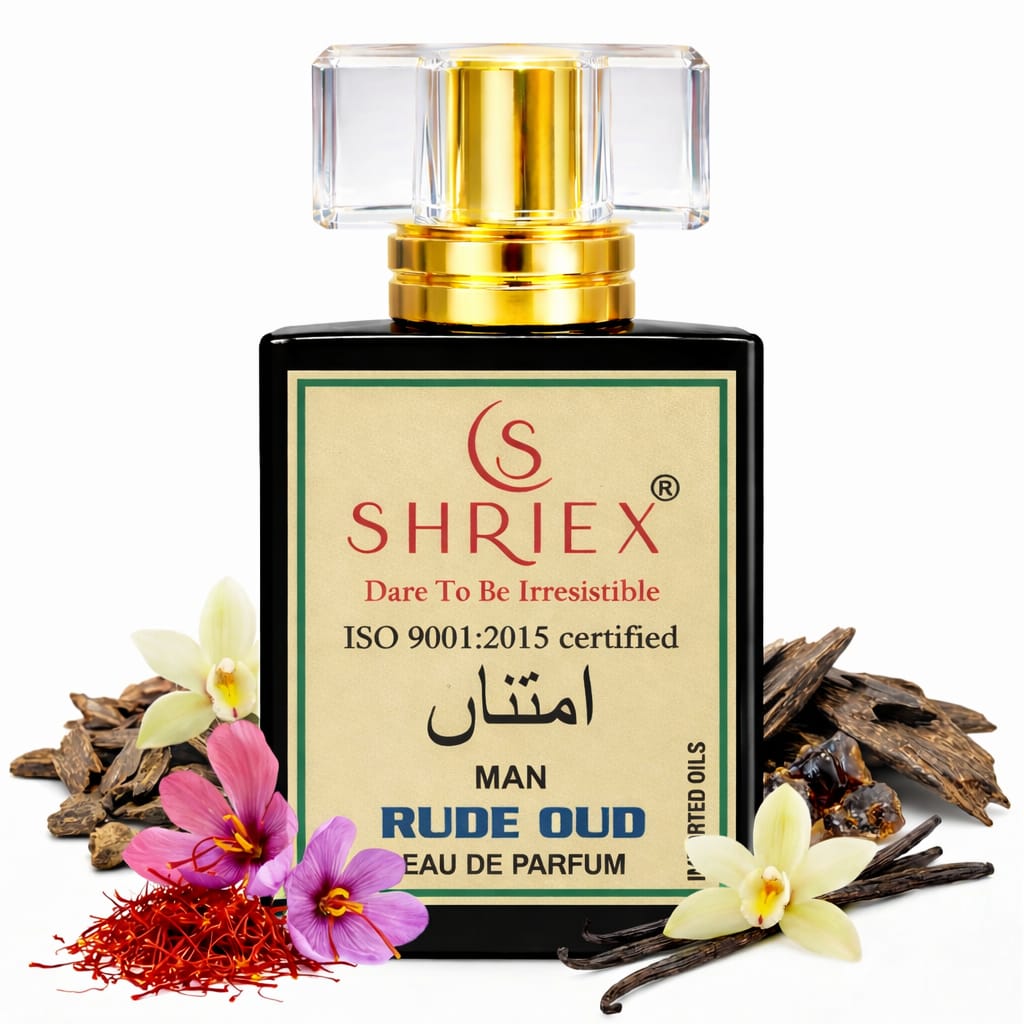
Luxury Without the Import Markup
A meaningful part of what inflates the price of an international fragrance sold in India isn’t the liquid inside the bottle — it’s import duty, currency conversion, multi-layer distribution, and the marketing budget required to sustain a global brand’s aura. None of that spend improves how the perfume actually performs on Indian skin, in Indian heat. By formulating, testing and manufacturing domestically, Shriex removes several of those cost layers entirely, passing the difference on as price rather than margin.
That shows up concretely across the brand’s perfume collection, where full-size Eau de Parfums sit at a fraction of what comparable imported alternatives cost, without pretending to be anything other than what they are — Indian-made, Indian-tested luxury fragrance.
The brand has also built its trial and gifting formats, available through its trial packs and gift sets range, specifically to lower the cost of discovery: six 8ml atomizers mixing men’s, women’s and unisex scents, letting a buyer find their signature scent before committing to a full bottle — a far cry from the take-it-or-leave-it economics of a department store counter.
Provenance Over Prestige
There’s a broader shift in Indian consumer psychology underpinning this. For years, luxury signalled itself through distance — a product was desirable partly because it came from somewhere else, endorsed by a heritage the buyer had no personal connection to. That’s changing. A newer generation of Indian consumers is increasingly drawn to provenance and honesty over borrowed prestige: they want to know where something was made, tested and by whom, not just which country’s flag is printed discreetly on the box.
Shriex’s own brand language leans directly into this shift, positioning itself with the tagline “Scent of India” rather than reaching for a European-sounding name, as many Indian fragrance brands still instinctively do. It’s a small decision with real commercial risk — foreign-sounding names have historically tested better with Indian luxury shoppers — but it signals a bet that the ground is shifting under that old assumption.
What “Accessible” Doesn’t Mean Here
It’s worth being precise about what accessible luxury means in Shriex’s case, because the phrase gets used loosely elsewhere in Indian retail to describe products that are simply cheap. Shriex’s manufacturing is aligned with ISO 22716:2007 cosmetic Good Manufacturing Practice, ISO 9001:2015 quality management, and US FDA compliance guidelines — the same formal standards a buyer would expect from a considerably pricier bottle. The affordability isn’t achieved by cutting corners on process; it’s achieved by cutting out the layers of cost that never had anything to do with quality in the first place.
That distinction — between cheap and honestly priced — is likely to matter more as Indian consumers become more literate about what they’re actually paying for in a luxury purchase. If that literacy continues to grow, brands built on the old markup-for-distance model will find it harder to justify their pricing on prestige alone. Brands like Shriex, built from the outset on a different set of assumptions, may find themselves less an alternative to Indian luxury perfumery’s mainstream, and more a preview of where it’s headed.